Winter Decorative Knots: 6 Cozy Projects Using Thick Rope and Yarn
October 30, 2026 - Decorative Knots

October 29, 2026 - Knot Types

Macrame asks very little of your wallet. A dowel, a ball of cord and a pair of sharp scissors will carry you through a first wall hanging, and much of what gets sold as a "complete starter bundle" is plastic you will never touch twice. What actually matters is having cord in a sensible thickness, a way to hold the work steady, and two or three small tools that keep your knots even and your fringe from unravelling.
So before you add anything to a basket, work through the list below. Twelve items, most of them already in a kitchen drawer, plus a handful of extras you can buy once you know this is a hobby and not a passing mood.
Most beginner frustration is cord frustration. Too thin and the knots look fussy and take forever; too thick and you cannot tighten them with your fingers alone. Three millimetres is the working thickness for wall hangings, plant hangers and small shelves, and it is where most patterns assume you are starting.
The other decision is construction. Single-twist cord has a loose, soft twist that fringes out into a lovely brush-like tassel, but it can untwist if you handle it roughly and it stretches under a heavy pot. Three-ply cord — three strands twisted together — holds a knot firmly, recovers its shape and is far more forgiving when you have to unpick something. For a first project, buy three-ply.
Natural off-white is the smartest colour to learn on, precisely because it shows everything: the light and shadow make it obvious whether a square knot is sitting snug or slightly loose. Dark cord hides your mistakes, which sounds kind and is not. A 100-metre spool is a comfortable first purchase; it covers a plant hanger or two plus a small hanging, with enough spare for practice.
You need a soft tape measure long enough to run the full length of a cord — 150 cm is plenty — and a rigid metre stick for checking cut lengths quickly against a table edge. Cut on a flat surface with the cord pulled straight, never straight out of a tangle, or your lengths will be short and your knots uneven.
For working out how much cord a project needs, the usual starting point is four times the finished length for each cord, since every length gets folded in half at the mounting stage. Add a little more for loose, open designs where the knots sit far apart, and a little less for dense panels where the cord is used up quickly. When in doubt, cut longer: an offcut costs pennies, and running out halfway through a row means starting over.
Newly cut cotton ends fray the moment you touch them. Wrap a turn of masking tape around each end as you cut, or dip the tip in clear-drying craft glue and let it set. Tape comes off before the end gets knotted into place, so keep the strips short and only on the very tip.
If your project shifts every time you pull a knot tight, you will spend more time re-adjusting than knotting. A macrame board — a foam or cork pad with a printed grid — is the tidiest solution: T-pins pushed through the cord hold the mounting dowel and individual rows exactly where you put them. A plain cork board works nearly as well for a fraction of the cost.
If you would rather not buy either, clamp your dowel to a table edge with a C-clamp or a spring clamp and let the cords hang free. For plant hangers and anything worked in the round, hang the ring from an S-hook over a door handle or a cupboard knob and work standing up. All three setups do the same job: they give your hands something to pull against.
Scissors. Small, sharp and kept for cord only. Cutting cotton rope is brutal on good fabric shears, and blunt scissors crush the end of a cord instead of slicing it, which makes threading and fringing harder.
A crochet hook, 4 to 5 mm. The most underrated item on this list. Use it to ease a stubborn knot tight, to pull a cord through a gap when your fingers are too big, and to hook loose tails back behind a panel. You will reach for it constantly.
A fine-tooth comb or slicker brush. For the final stage, when you brush out the fringe so it hangs straight and full. Comb slowly from the ends upward; rushing produces a frizzy cloud that cannot be undone.
A spray bottle of water. A light mist relaxes cotton fibres, helps knots settle into an even row and tames static and flyaway fuzz. Mist, do not soak, and let the piece dry flat.
Masking tape and clear-drying glue. One for holding cut ends together while you work, the other for sealing the final tails so a plant hanger does not quietly shed strands over the years. Neither is expensive and both save you from re-doing a finish.
Add a shallow basket or a cloth project bag and you are done. It is less a tool than a habit: cord offcuts are useful for practising new knots, and a bag means a project can be picked up for twenty minutes and put down without unravelling itself on the floor.
Once you have finished one piece, a few additions start to make sense. Wooden beads and metal rings, sized so the cord passes through comfortably, turn a plain panel into something more deliberate. A second cord colour lets you try stripes and colour-blocked sections. A cord winder keeps long lengths from tangling, and fabric stiffener helps a wall hanging hold a crisper shape near the top.
What you can safely skip: pre-cut cord packs in lengths too short for anything but one specific pattern, plastic "knotting frames" that only accept one cord thickness, and any bundle that includes tools you already own. Buy the pattern-specific supplies when you have a project that needs them, not before.
Here is a concrete start. Cut eight lengths of 3 mm cord at roughly 3 metres each, mount them with lark's head knots onto a 30 cm dowel pinned to your board, and work alternating square knots down the panel, finishing with a row of double half hitches and a brushed-out fringe. That gives you the two knots that unlock most beginner patterns and a finished hanging in an afternoon.
Write down the number of cords, the lengths you cut and the knots you used on a scrap of paper. When you make something you like, that note is the only record you will have — and it is the difference between repeating a good piece and guessing at it six months later.
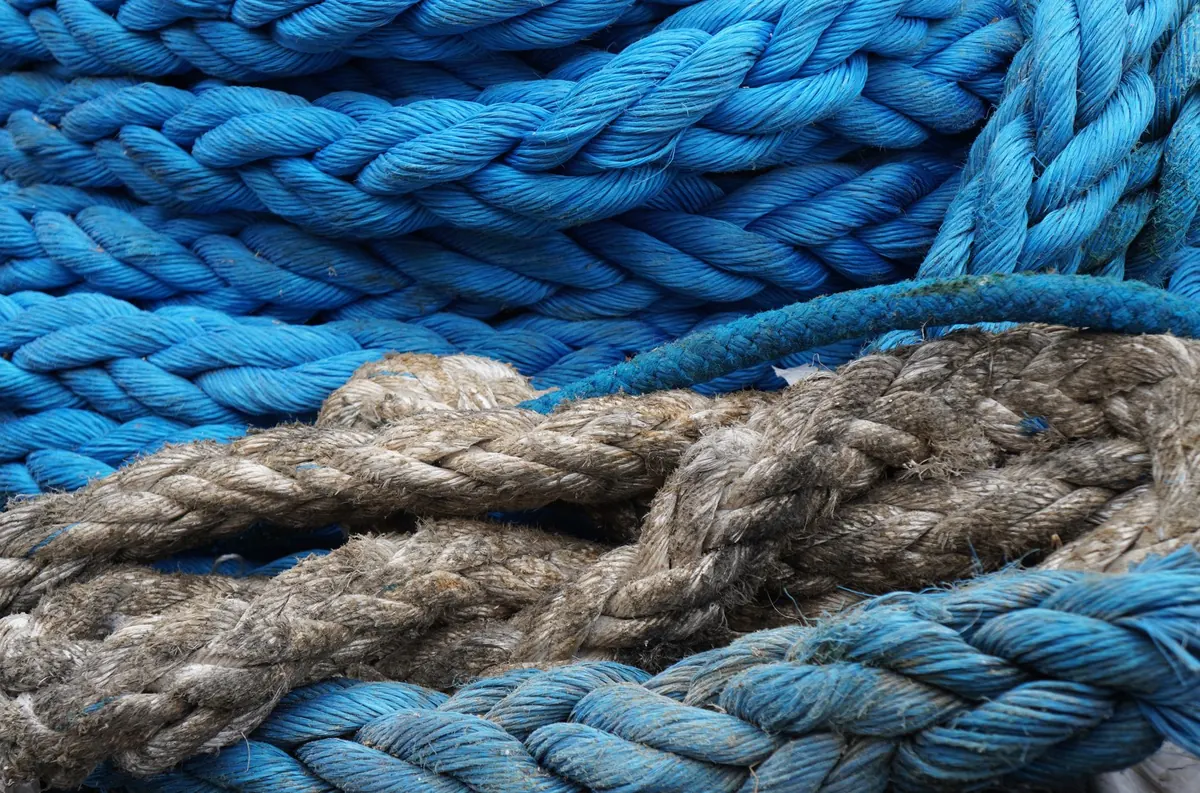
Photo: bilgecangurer / Pixabay
Six winter knot projects in thick rope and chunky yarn — wreath, doorstop, garland, trivet, basket and ornaments —...
A guide to traditional Italian maritime knots — bowline, clove hitch, constrictor — and how their forms translate...
Copyright © 2026 Nodi Lontano. All Right Reserved.